Žyma: ekonominis augimas

Lithuania in Europe’s Economic Race: How a Small Baltic Nation Is Sprinting Past Its Rivals

Economics & Science · Research Digest

Economic Research

A new mathematical model reveals why Lithuania may top Central and Eastern Europe in GDP per capita by 2030 — and what a flock of starlings has to do with it.

In late March 2026, a new seminar series opened at the Institute of Lithuanian Scientific Society — named after the economist Jonas Pranas Aleksa. The inaugural talk was delivered by Prof. Vygintas Gontis, and its subject was deceptively modest: how Lithuania managed to become one of the fastest-growing economies in Central and Eastern Europe. The answer, it turns out, involves birds.

The research behind the lecture, published in two recent papers on arXiv, proposes a fresh lens for understanding how economies grow. Forget the usual policy prescriptions and microeconomic tinkering. What if the most important dynamics of economic development happen at the macro level — visible only when you step back far enough to see the whole flock?

The Murmuration of Markets

Have you ever watched a murmuration of starlings — that fluid, shape-shifting cloud of thousands of birds moving as one? No single bird is in charge. No one issues commands. Each bird simply watches its neighbours and adjusts. The result is breathtaking collective intelligence.

„Countries don’t need to invent the smartphone from scratch. They just need to watch someone else profit from it.”

Prof. Gontis and his collaborators argue that technology adoption among nations works the same way. They call it the herd model. When a wealthier country adopts a technology and visibly prospers, neighbouring countries notice — and imitate. Two forces drive this imitation:

Force 1 — Personal incentive

„This new technology lets me earn more.” Pure rational calculation.

Force 2 — Social pressure

„Everyone else is adopting it. If I don’t, I’ll fall behind.” The herd instinct.

Together, these two forces create a powerful engine of catch-up growth — especially for countries that are far behind the technological frontier. The further behind you are, the faster you can theoretically catch up, because the gap between your current state and what’s possible is enormous.


The Mathematics of Catching Up

To turn this intuition into something testable, the researchers built a mathematical model. It is elegant in its simplicity: each country begins at some level of technological development, the most advanced countries set a moving frontier, and lagging nations close the gap over time — but not at the same rate.

As a country nears the frontier, the pace of catch-up slows. This makes intuitive sense: there are fewer obvious imitation opportunities left, and the remaining innovations are genuinely hard to copy. The model produces a characteristic S-shaped curve of productivity growth.

The researchers tested this model against decades of real data from Central and Eastern European countries, comparing them against benchmarks like Germany and the United States. The fit was striking. Countries genuinely do follow the predicted trajectory — accelerating when far behind, slowing as they approach the leaders.


The Secret Variable: Debt

But not all countries catch up at the same speed. Some sprint. Others jog. A few stumble. What explains the difference?

The researchers found a surprisingly powerful predictor: private sector debt. Specifically, the level of household and corporate borrowing from banks.

Key Finding In one of their papers, the authors demonstrate that the single greatest influence on a Central or Eastern European country’s catch-up speed is the trajectory of its private debt. Countries that built up excessive credit before the 2008 financial crisis are still paying the price — literally — in slower productivity growth.

Countries that over-borrowed before 2008 spent the following decade deleveraging — paying down debt rather than investing in new technologies. This depressed their catch-up speed precisely when they should have been accelerating.

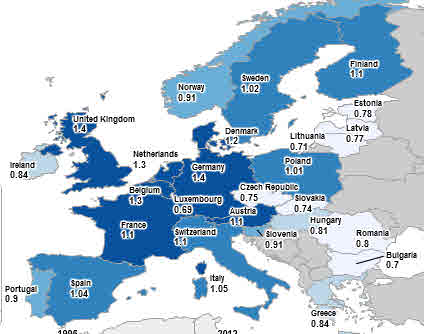
Lithuania’s story is the inverse. It entered the 2008 crisis with relatively modest private debt levels. The crisis was painful — Lithuania suffered one of the sharpest GDP contractions in the EU — but the country emerged leaner, with its balance sheets clean and its capacity to invest intact. The low-debt position, the model suggests, is the structural reason Lithuania has since been able to grow so fast.

#1 Projected CEE ranking by GDP per capita in 2030
1995 Start year for the CEE economic dataset used in the model
2050 Forecast horizon in the longer-term model projections

Contrasts: Romania Rockets, Slovenia Stalls

The elegance of the model lies in what it reveals about individual countries’ trajectories. Two contrasting cases stand out.

Romania started from a very low productivity base — which actually works in its favour. With such a large gap to close, even modest technology adoption generates dramatic percentage gains. The model projects rapid growth continuing well into the 2030s.

Slovenia, meanwhile, presents a cautionary tale. It began from a higher base than most CEE countries — closer to the Western European frontier — but its private debt dynamics have weighed on its catch-up speed. The model predicts slower convergence, confirming what the data has shown for the past decade.

Lithuania’s low pre-crisis debt isn’t just historical trivia. The model treats it as the decisive structural advantage that explains the country’s exceptional economic sprint.

A Different Way of Seeing Economics

Perhaps the most intellectually interesting aspect of this research is its methodological stance. The authors explicitly reject the conventional microeconomic approach of building up from individual agents, firms, and market interactions.

Instead, they adopt the perspective of an outside observer watching the whole system. Like a biologist studying a murmuration rather than tracking individual birds, they look for macro-level patterns — the collective dynamics that emerge from millions of individual decisions but cannot be reduced to any of them.

This approach, borrowed partly from statistical physics, allows them to sidestep the „noise” of micro-level fluctuations and identify the underlying signal: the smooth, predictable curve of technological catch-up. The model is explicitly approximate. It doesn’t account for political upheaval, institutional quality, or individual crises. But its authors argue that this simplicity is a virtue — it reveals the structural forces that operate beneath the policy noise.

IMF & Model Consensus Forecast — 2030

Lithuania overtakes all Central & Eastern European peers in GDP per capita

Driven by the lowest pre-crisis private debt accumulation in the CEE region


Why This Matters Beyond Lithuania

The implications reach well beyond one small Baltic nation. If the herd model is correct, then economic policy advice that ignores private debt dynamics and focuses only on innovation, education, or institutional reform may be missing the central variable.

It also offers a more optimistic reading of development economics. Growth, in this view, is not primarily about rare genius or fortunate geography. It is a social process — systematic, learnable, and to a significant degree predictable. Countries that watch, imitate, and invest wisely will catch up. The mathematics says so.

For Lithuania, the message is one of hard-won vindication. The brutal austerity of 2009–2010, widely criticised at the time, left the country with clean books precisely when it needed them most. The sprint that followed wasn’t luck. It was structure.

The Bottom Line

Economic growth isn’t only about inventing new things. It’s about the social process of watching, learning, and adopting what works — fast enough to matter. Lithuania’s advantage isn’t genius or luck. It’s a balance sheet kept clean when others borrowed recklessly. The mathematics of catch-up says the sprint isn’t over yet.

The Project of a Common European Economic Area

Christmas is an appropriate time to share good news. In collaboration with ChatGPT, we have produced comparative maps of the European economy for 1995 and 2024, based on IMF World Economic Outlook (WEO) data. The good news is that the European map in 2024 is incomparably more even and balanced than in 1995. This clearly demonstrates the real benefits of European economic integration and substantially weakens recurring claims about Europe’s alleged economic stagnation.

Skaitykite toliau

Is the United States’ Productivity Advantage Merely a Result of the Chosen Measurement Methodology?

Global economic media frequently report that U.S. productivity has been growing much faster than in Europe and other developed Western economies for many years. As an example, consider the recent publication in the Financial Times (FT) [1]. This is not journalistic exaggeration—such conclusions follow directly from the still widely used methodology of calculating real GDP and productivity, and from international comparisons based on that methodology.

Skaitykite toliau

The Main Reason for Lithuania’s Economic Success – Low Private Debt.

Together with Assoc. Prof. Lesya Kolinets, lecturer in international macroeconomics at VILNIUS TECH and professor at Ternopil National Economic University, and I prepared a scientific manuscript (Gontis et al., 2025, arXiv:2510.04211) on the economic development of Central and Eastern European (CEE) countries from 1995 to 2024.
The results of this study may be of interest to a broad audience seeking to gain a deeper understanding of the reasons behind
Lithuania’s economic success since regaining independence. Using relatively simple econometric tools, we identify the key macroeconomic and financial components of CEE economic growth, among which low private debt accumulation emerges as a particularly significant factor.

Skaitykite toliau

II pakopos pensijų fondai griauna valstybę

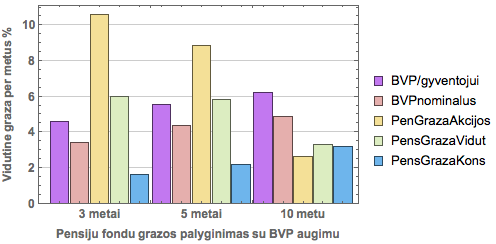
PensFondGrazaVerslo žinios neseniai iškilmingai paskelbė, kad II pakopos pensijų fondų dalyvių santaupos artėja prie 3 milijardų eurų. Šis pranešimas susilaukė Prof. R. Lazutkos FB komentaro ir daugybės diskusijų visiems aktualiu klausimu. Mūsų nuomone, visoms toms diskusijoms labai trūksta makroekonominės dimensijos, kuri turėtų praskaidrinti jau užsitęsusias diskusijas apie II pakopos pensijų fondų naudą ar žalą. Naudos šalininkai nepaliaujamai tvirtina, kad šie fondai yra vos ne vienintelė priebėga nuo neefektyviai veikiančios valstybinės socialinės apsaugos sistemos vadinamos SODRA ir vienintelė gali užtikrint sočią senatvę dabartiniams mokesčių mokėtojams. Jie teigia, kad dabartinė Sodros sistema vadinama PAYG (pay as you go, kai Sodros įmokos išmokamos dabartiniams pensininkams) negali duoti grąžos, o II pakopos pensijos fondų grąža yra užtrintas būdas kaupti senatvei.

Parodysime, kaip remiantis makroekonomine logika, galima teisingai įvertinti II pakopos pensijos fondų vaidmenį valstybės raidai ir naudą jos gyventojams. Nors Sodra dažnai traktuojama kaip socialinis draudimas, bet ji realizuojama per privalomus mokesčius ir ekonomine prasme nesiskiria nuo visų kitų valstybės socialinių funkcijų vykdymo. Todėl Sodros garantas yra valstybės kuriamas BVP (bendrasis vidaus produktas) nuo kurio ir yra surenkamas Sodros biudžetas. Todėl kartu su augančiu BVP auga ir Sodros biudžetas. Šį Sodros biudžeto augimą galima vadinti jos grąža, nors dalinai yra teisūs ir tie, kurie atsisako tai vadinti grąža, nes nemato tame investavimo aspekto. Mums svarbiau ne ginčai terminijos klausimais, bet ekonominis II pakopos fondų naudos valstybei ir gyventojams įvertinimas. Skaitykite toliau

Nedeklaruotas darbas ES: pastabos vertinimui, naudojančiam darbo apmokestinimo metodą.

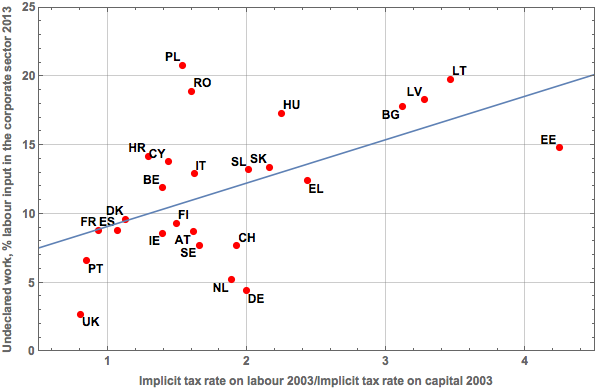
Pačioje praėjusių metų pabaigoje Prof. Romas Lazutka savo FB paskyroje pasidalino informacija apie ES Komisijos užsakymu atliktą tyrimą: „An evaluation of undeclared work in the European Union and its structural determinants: estimates using the Labour Input Method„. Svarbiausia šio darbo išvada buvo pristatyta kaip įrodymas, kad darbo apmokestinimo lygis ES šalyse praktiškai neturi jokios įtakos nedeklaruoto darbo lygiui. Komentaras ir pats darbas susilaukė pakankamai daug kritikos, kadangi jis prieštarauja populiariam įsitikinimui dėl aukšto darbo apmokestinimo įtakos nedeklaruoto darbo lygiui. Reikia pripažinti, kad autorius taip pat iki šiol perdėtai vertino mokesčių vaidmenį makroekonominei šalių raidai, nors ankstesni darbai apie Baltijos valstybių ekonominį augimą greičiau liudijo priešingai.  Todėl šis tekstas gimė, kaip natūralus noras giliau suprasti  darbo ir kapitalo mokesčių įtaką šalių BVP ir nedeklaruotam darbui.

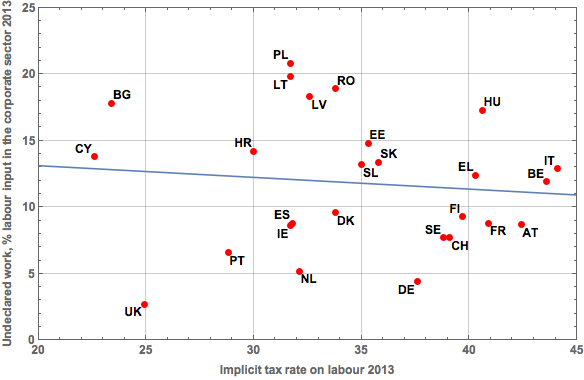
Daugiausiai abejonių kelia nagrinėjamos studijos teiginys apie praktiškai neegzistuojančią koreliaciją tarp ES šalių darbo bendrojo apmokestinimo lygio (Implicit tax rate on labour (ITR(L)) ir nedeklaruoto darbo (Undeclared work) , žr. 1 pav., kuris aiškiai rodo labai mažą tiesinę koreliaciją lygią -0.105. Šis ir kiti paveiksliukai parengti autoriaus pagal nagrinėjamos studijos ir „Taxation Trends in the European Union Data for the EU Member States, Iceland and Norway, 2017 edition” duomenis.


UndWork pav 1

1 pav. Autoriaus iliustracija pagal duomenis iš cituojamų Eurostato studijų, koreliacija -0.105. Skaitykite toliau

Nuobodus realaus BVP argumentas, naudojamas prieš Eurą

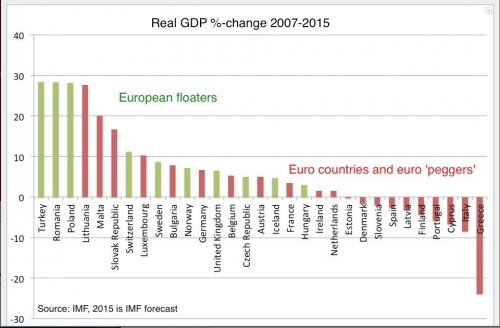
Nors Paul Krugmanas yra viena ryškiausių asmenybių, kritikuojančių Euro idėją [1], kiti profesionalūs ekonomistai ir žurnalistai taip pat daug prisideda viešai kritikuodami Euro zonos makroekonominę politiką. Graikijos problema taip pat tapo didelių diskusijų objektu, kadangi jaučiamas pastovus nuomonių, nuo tiesioginio Euro projekto neigimo iki visų jo įgyvendinimo etapų kritikos, spaudimas. “Supraskite”, pagrindinė Europos ekonominio vystymosi problema kyla iš blogos bendros valiutos idėjos ir jos klaidingo įgyvendinimo dėl to stringa ir visas ES projektas.

Šiomis pastabomis nesiekiame nagrinėti galimas geopolitines aplinkybes, lemiančias šio nuomonių srauto kryptį, norime tik atkreipti dėmesį, kad labai dažnai šios nuomonės remiasi klaidingu argumentu. Pasirodė naujų straipsnių [2,3], kurie lygina Europos šalių jau įsivedusių Eurą arba susiejusių savo valiutas su Euru ir Europos šalių, toliau leidžiančių nacionalinėms valiutoms plaukioti, realiuosius BVP. Visai nėra būtina tapti tarptautinės makroekonomikos ekspertu, norint suprasti ryšį tarp šalių monetarinės politikos ir jų realaus BVP augimo. Plaukiančios valiutos daro įtaką šalies produktų ir paslaugų kainoms ir taip keičia bendrojo produkto augimo pasidalijimą tarp jo realiosios dalies ir infliacinės dalies (delfliatoriaus). Dėl tos priežasties realusis BVP yra labai priklausomas nuo nacionalinės valiutos svyravimų ir todėl tampa mažiau naudingas lyginti šalis, turinčias skirtingas pinigų politikas. Šią problemą puikiai žino ekonominio augimo statistikai ir todėl pasitelkia perkamosios galios paritetą (PGP) perskaičiuoti BVP, naudojant kainų lygius įvairiose šalyse, matuojamus ta pačia valiuta. Skaitykite toliau

Baltijos valstybės turi realias galimybes išlikti ilgalaikio ekonominio augimo lyderėmis ES

Vygintas Gontis, Aleksejus Kononovičius ir Kęstutis Acus

EU FigAnkstesniame tekste pateikėme statistinę informaciją iš įvairių šaltinių, demonstruojančią ypatingai sparčius ir stabilius Baltijos šalių ekonomikų ilgalaikio augimo tempus. Šiandien jau drąsiai galima teigti, kad net pasaulio finansinė krizė šioms stabilaus augimo tendencijoms galėjo padaryti tik trumpalaikį poveikį. Baltijos šalys vėl yra ES ekonominio augimo lyderėmis ir siekia išlikti tokiomis ateityje.

Tai, kad Baltijos šalių ekonomikos net pasaulinės ekonominės krizės sąlygomis pirmiausiai stiprėja augančio eksporto dėka, tik patvirtina prielaidas apie ypatingai ryškų Balassa Samuelsono efekto pasireiškimą. Tačiau klausimas, kodėl šis efektas pasireiškia stipriau šiose šalys, reikalauja atskiros analizės. Pavyzdžiui, Vyšegrado šalys, kurių bendrojo vidaus produkto (BVP) lygis yra labai artimas, atrodo turėtų vystytis panašiu greičiu. Nesileisdami į detalesnius modelinius šio klausimo aspektus, norėtume atkreipti dėmesį į darbo užmokesčio statistiką, nes darbo už mokestis yra labai svarbus daugelio makroekonominių augimo modelių parametras.