
Christmas is an appropriate time to share good news. In collaboration with ChatGPT, we have produced comparative maps of the European economy for 1995 and 2024, based on IMF World Economic Outlook (WEO) data. The good news is that the European map in 2024 is incomparably more even and balanced than in 1995. This clearly demonstrates the real benefits of European economic integration and substantially weakens recurring claims about Europe’s alleged economic stagnation.
Skaitykite toliau
Is the United States’ Productivity Advantage Merely a Result of the Chosen Measurement Methodology?
Global economic media frequently report that U.S. productivity has been growing much faster than in Europe and other developed Western economies for many years. As an example, consider the recent publication in the Financial Times (FT) [1]. This is not journalistic exaggeration—such conclusions follow directly from the still widely used methodology of calculating real GDP and productivity, and from international comparisons based on that methodology.
Skaitykite toliauCan Lithuania catch up with and even overtake Western Europe? This question is provocative—but not without foundation. A recent study (Gontis et al., 2025, arXiv:2510.04211) showed that Lithuania’s economic progress stands out among the countries of Central and Eastern Europe (CEE). Yet can this growth pace enable it to reach the level of Malta and other Western economies? Using the same data and methodology, we compared the development of Malta and Spain to identify which factors determine successful convergence.
Skaitykite toliau
Together with Assoc. Prof. Lesya Kolinets, lecturer in international macroeconomics at VILNIUS TECH and professor at Ternopil National Economic University, and I prepared a scientific manuscript (Gontis et al., 2025, arXiv:2510.04211) on the economic development of Central and Eastern European (CEE) countries from 1995 to 2024.
The results of this study may be of interest to a broad audience seeking to gain a deeper understanding of the reasons behind Lithuania’s economic success since regaining independence. Using relatively simple econometric tools, we identify the key macroeconomic and financial components of CEE economic growth, among which low private debt accumulation emerges as a particularly significant factor.
Comparing the economic development of countries is not as straightforward as it may seem to many. The most commonly used indicator—Gross Domestic Product (GDP) per capita or per employee—can vary significantly depending on the currency used and how inflation in goods, services, and money is accounted for. What complicates comparison most is that exchange rates between currencies do not reflect differences in purchasing power across the countries being compared.
To address this issue, the Purchasing Power Parity (PPP) method has been developed, which introduces a real exchange rate that accounts for price level differences between countries. As a result, economic statistics experts around the world generally agree that international comparisons of economic development must be based on the PPP method.
However, we must acknowledge that in the public domain—including even in widely recognized sources of economic information—other comparison methods are often used. Most commonly, we see countries compared by real GDP, adjusted to constant prices and expressed in a common currency. It should come as no surprise that such comparisons often yield very different results than those based on PPP.
In this brief overview of economic development in Central and Eastern Europe (CEE), we rely on data from the International Monetary Fund (IMF) World Economic Outlook (WEO) database, using the PPP method. The selected period spans 1995 to 2030, for which this data is available. Understandably, figures from 2025 to 2030 are projections, but they are based on the best available macroeconomic models and the observed development of each country up to 2024.
Below, an interactive country comparison chart presents both the absolute values of GDP per capita in international US dollars (click „Scores”) and the ranking of each country relative to others (click „Rank”).
Both visualizations are highly valuable.
- The “Scores” view gives a compelling sense of how successfully CEE countries have integrated into the Western economic space: GDP growth reaches up to tenfold.
- There is no doubt that the new EU member states are rapidly converging with the old ones, confirming the economic success and benefits of the EU project for CEE countries.
Country-by-country comparison becomes even more dynamic when shown by ranking in the “Rank” view. In this visualization, Lithuania advances from the second-lowest position in 1995 to a projected leadership role by 2030. Had we included Southern European countries such as Italy, Spain, Portugal, and Greece, it would become clear that Lithuania is expected to lead even among them.
Although Lithuania still faces many unresolved social challenges, it can rely on a strong economic foundation as it seeks the best available ways to overcome them.
The Institute of Lithuanian Scientific Society, in cooperation with Ukrainian scholars working in Lithuania, seeks to commemorate the Battle of Vorskla, which took place on August 12, 1399. This sociocultural project is especially relevant today, reminding us of the historical roots of cooperation between the Lithuanian and Ukrainian nations. Although the Christian alliance, composed of Lithuanian, German, Polish, Ruthenian, and Moldavian forces under the leadership of Grand Duke Vytautas, suffered a painful defeat, this battle should not only be remembered but also reconsidered in the broader context of civilizational development.
Grand Duke Vytautas commemorated the Battle of Vorskla by founding a church in Kaunas.

We organized several informational events to raise awareness of the Poltava City Council’s decision to commemorate the Battle of Vorskla at the site of the Poltava Battle Museum in Ukraine. You are welcome to explore them:
- Project presentation event — Youtube recording
- Public lecture by Professor Valdas Rakutis: “The Battle of Vorskla (1399) and Kaunas” (January 12, 2025) — Youtube recording
Historical sources confirm that, despite having a military-technological advantage, the Christian coalition could not overcome the Golden Horde’s forces, which outnumbered them threefold. The battle claimed many lives. Historical memory and respect for those who perished are of immeasurable value to the identity and future perspective of the nations of this region.
The Battle of Vorskla took place on the frontier of the Grand Duchy of Lithuania, in what is now Ukrainian territory, near the Vorskla River. It was a dramatic clash between Christian and Tatar nomadic civilizations, manifested in military conflict. The exact location of the battle remains unknown, as no remains or burial sites of soldiers have been discovered. Historians must rely on the chronicle of Swedish historian Gustaf Adlerfelt, who recorded that the 1709 Battle of Poltava occurred on the same field as Vytautas the Great’s Battle of Vorskla.
625 years later, the Poltava City Council, following an initiative by Dr. Ganna Nevoit and supported by the local community, resolved to commemorate the Battle of Vorskla. The council approved both the monument’s design and its location within the protected grounds of the Poltava Battle Museum, which is believed to be the site of the battlefield. The museum administration agreed to take over the completed monument into its care and maintenance.
Remembering lost battles and those who died is just as critical as celebrating victories. Regardless of the outcome, battles give us insight into the political and military history of their time. From the perspective of historical memory, they allow us to discover and highlight the continuity of values and ideas. We now have an excellent opportunity to honor the historical cooperation between the Lithuanian and Ukrainian nations, which will undoubtedly remain significant for their future destinies.
Therefore, we invite everyone who can contribute to the necessary funding for the monument’s installation. The Institute of Scientific Society (short Lithuanian MSI) takes responsibility for collecting donations in Lithuania. It will cooperate with the Ukrainian Scholars Section of the Lithuanian Scientific Society and Dr. Ganna Nevoit to implement the project and formally hand over the monument to the Poltava Battle Museum.
You can donate with a single click of the “Donate” button at the beginning of this appeal.
Please note that you can allocate a portion of the donation as a tip to the WhyDonate platform developers during payment. If you wish your donation goes to the Vorskla project, set the “Tips” slider to 0%.
On behalf of the MSI and Ukrainian scholars working in Lithuania, we also address companies and entrepreneurs regarding opportunities to collaborate in commemorating the Battle of Vorskla at the Poltava Battle Museum. This may also become the beginning of broader cooperation with Ukrainian researchers, both in Lithuania and beyond.
We are always ready to meet and discuss collaboration opportunities.
If you are interested in supporting this project, please contact MSI Director Prof. Dr. Habil. Vygintas Gontis at vygintas@gontis.eu or tel. +370 698 12384,
or Poltava Council Member Dr. Ganna Nevoit at anevoiyt@gmail.com to receive more details directly from the project’s initiators.

Mokslininkų sąjungos institutas, bendradarbiaudamas su Lietuvoje dirbančiais Ukrainos mokslininkais, siekia įamžinti atminimą apie Vorsklos mūšį, vykusį 1399 metais rugpjūčio 12 d. Šis socialinis kultūrinis projektas tapo ypatingai aktualus šiandien, kai ieškome istorinių lietuvių ir ukrainiečių tautų bendradarbiavimo šaknų.
Nors tą mūšį jungtinės krikščioniškai civilizacijai atstovaujančios Vytauto didžiojo vadovaujamos lietuvių, vokiečių, lenkų, rusėnų, moldavų pajėgos skaudžiai pralaimėjo, jo ne tik negalime užmiršti, bet privalome naujai permąstyti bendrame civilizacijų istorinės raidos kontekste. Istoriniai šaltiniai patvirtina, kad tuo metu turėtas karinis technologinis pranašumas prieš Aukso ordos tris kartus kiekybiškai didesnes pajėgas nebuvo pakankamas, o mūšis nusinešė labai daug gyvybių. Istorinė atmintis ir pagarba žuvusiems turi neįkainuojamą vertę ir tolimesnei šio regiono tautų savimonei bei tolimesnės raidos perspektyvai.
Mūšis vyko Lietuvos didžiosios kunigaikštytės pakraštyje, dabartinės Ukrainos teritorijoje, šalia Vorsklos upės ir savo esme yra vienas ryškiausių istorinių krikščioniškosios ir totorių klajoklių kultūrų susidūrimų, pasireiškusių kariniu konfliktu. Klausimas dėl tikslios mūšio vietos nėra išspręstas, nes taip ir nepavyksta rasti karių palaikų ar kitų laidojimo ženklų. Tenka remtis švedų istoriko Karolio XII metraštininko Gustafo Adlerfeldo įrašais apie tai, kad Poltavos 1709 m. mūšis vyko tame pačiame lauke, kaip ir Vytauto Didžiojo Vorsklos mūšis.
Praėjus 625 metams, Poltavos miesto taryba, daktarės Ganna Nevoit iniciatyva ir miesto bendruomenei palaikant, priėmė sprendimą įamžinti Vorsklos mūšio atminimą. Taryba taip pat patvirtino paminklo projektą ir jo įrengimo vietą Poltavos mūšio lauko teritorijoje, kur ir, manoma, vyko Vorsklos mūšis. Projekto vizualizaciją pridedame. Kadangi numatyta vieta yra saugomoje Poltavos mūšio teritorijoje, prižiūrimoje Poltavos mūšio muziejaus, yra gautas muziejaus sutikimas perimti pastatytą paminklą į savo balansą, saugoti jį bei prižiūrėti.
Atmintis apie pralaimėtus mūšius ir juose žuvusius yra nemažiau svarbi nei skambios pergalės. Nepriklausomai nuo rezultato, mūšiai leidžia pažvelgti į to laikmečio politinę, karybos istoriją, o istorinės atminties požiūriu matyti ir atrasti idėjų tęstinumą. Turime puikią galimybę įamžinti lietuvių ir ukrainiečių tautų bendradarbiavimo istoriją, kuri neišvengiamai ir toliau bus svarbi tolimesniam šių tautų likimui. Todėl prašome visus galinčius prisidėti prie reikalingų lėšų paminklo įrengimui surinkimo. Viešoji įstaiga „Mokslininkų sąjungos institutas“ (MSI) imasi atsakomybės lėšas rinkti Lietuvoje ir bendradarbiaus su Lietuvos mokslininkų sąjungos ukrainiečių mokslininkų skyriumi bei daktare Ganna Nevoit šį paminklą įrengiant numatytoje vietoje ir perduodant jį Poltavos mūšio muziejui.
Dėl savo ketinimų prisidėti prie šio projekto įgyvendinimo prašome kreiptis į MSI direktorių Dr.(Habil) Vygintą Gontį vygintas@gontis.eu, tel. +370 698 12384, arba Dr. Ganna Nevoit, anevoiyt@gmail.com, jei norėtumėt gauti daugiau informacijos apie projektą iš pirmų lūpų.
Vygintas Gontis, Aleksejus Kononovičius, Julius Ruseckas
Teorines fizikos ir astronomijos institutas, Vilniaus universitetas, Sauletekio al. 3, 10257 Vilnius, vygintas@gontis.eu
Physics research complements traditional approaches, such as mathematical (stochastic) finance and econometrics in quantitative economics and finance [1, 2]. In the early years of this millennium, we embarked on an interdisciplinary research endeavor in Lithuania, applying concepts from statistical physics to understand complex financial and social systems. Here, we provide a short review of investigations in Lithuania, spanning from 2008 to 2022, undertaken by our research group.
The term „Econophysics” was coined by Professor H. E. Stanley over three decades ago, merging the disciplines of Economics and Physics. While the precise definition of „Econophysics” remains subject to ongoing debate, numerous reputable research groups and scientific journals worldwide are actively contributing to its development.
Our journey into Econophysics prompts the intriguing question of how theories primarily designed to explain the physical world in terms of particles can be applied to unravel the complexities of human social and economic behavior. Physics, as a natural science, is renowned for its precision and predictive power, grounded in the utilization of a limited set of universal properties of matter, sufficient to elucidate a multitude of physical phenomena. In stark contrast, the social sciences lack equivalent precise universal properties for individuals. Human beings, unlike fundamental particles, differ significantly from one another in numerous aspects. Despite this fundamental distinction between physical and social systems, the analogy between statistical laws in physics and social sciences continues to drive the application of statistical physics to investigate the properties of financial and other social systems.
Skaitykite toliau
Vygintas Gontis, Aleksejus Kononovicius, Julius Ruseckas
Teorines fizikos ir astronomijos institutas, Vilniaus universitetas, Sauletekio al. 3, 10257 Vilnius, vygintas@gontis.eu
Fizikos tyrimo metodų taikymas papildo tradicinius finansinių, ekonominių ir kitų socialinių sistemų tyrimo būdus: ekonomiką, finansų matematiką ir ekonometriją [1, 2]. Jau pačioje šio amžiaus pradžioje mūsų grupės nariai ėmėsi Lietuvoje naujos tarpdisciplininės tyrimų krypties, pradėdami taikyti statistinės fizikos metodus ir aiškindamiesi sudėtingų finansinių bei kitų socialinių sistemų veikimą. Šiuos inovatyvius mūsų grupės moksliniius tyrimus apžvelgiame laikotarpiu nuo 2008 iki 2022 metų.
Terminas „Ekonofizika”, jungiantis ekonomikos ir fizikos disciplinas, pradėtas naudoti daugiau nei prieš 30 metų profesoriaus H. E. Stanley iniciatyva. Nors tikslesnio ir išsamesnio šio termino apibrėžimo vis dar ieškoma, daug pripažintų tyrimo grupių ir mokslo žurnalų visame pasaulyje prisideda prie sparčios tarpdisciplininės mokslo srities plėtros. Polymerų studijų centras Bostono universitete, kuriam vadovauja prof. H. E. Stanley, yra tapęs viso pasaulio Ekonofizikos specialistų traukos centru. Verta pastebėti, kad V. Gontis 10 mėnesių 2014-2015 metais stažavosi šiame centre taip pat.
Skaitykite toliau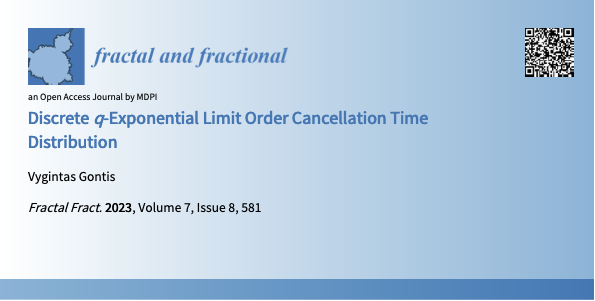
Tyrinėdami socialines sistemas ir ypatingai finansines turime pasirinkti prielaidas ir matematinį (stochastinės laiko eilutės) ar fizikinį (agentų) modelį. Nepaisant to, kad empirinių duomenų prieinamumas pasiekė dar neregėtas galimybes, tinkamo, teisingo modelio pasirinkimas išlieka sunkiausiai sprendžiama problema. Pavyzdžiui, tiriame empirines sistemas, ieškodami jose ilgos atminties ir prognozavimo galimybių, naudodami matematinius laiko eilučių modelius, kuriuose ta atmintis yra išankstinė prielaida. Akivaizdu, kad taip įvertinta tiriamos sistemos atmintis turi prasmę tik tuo atveju, jei teorinė prielaida apie tos atminties kilmę atitinka tikrovę.
Savo ankstesniame darbe [1] tyrėme sandorių pavedimų srauto finansų rinkose laiko eilutes, remiantis pačia bendriausia Trupmeninio L’evy stabilaus stochastinio proceso (TLSSP) prielaida, ir parodėme, kad šios prielaidos pagrindu turime pripažinti pavedimų srauto antikoreliacines savybes. Tiriamas laiko eilutes apibrėžėme pačiu paprasčiausiu būdu, sumuodami pavedimų apimtis: pirkti \(v_k^{+}(t_j)\) ir parduoti \(v_k^{-}(t_j)\) akcijas
\[ X(j)=\sum_{k=1}^{10}(v_{k}^{+}(j)-v_{k}^{-}(j))=V^{+}(j)-V^{-}(j)=\sum_{i=1}^{j}Y(i).\label{eq:order-disbalance} \] Čia \(X(j)\) yra sandorių (nuomonių) disbalansas laiko momentu \(j\), indeksas \(k\) žymi 10 kainos lygių virš ir žemiau pirkti-parduoti tarpo, \(V^{+}(j)\), \(V^{-}(j)\) atitinkamai reiškia bendras apimtis pirkti ar parduoti akcijas momentu \(j\), \(Y(i)\) yra disbalanso pokyčiai, kurie atsiranda dėl prekiautojų teikiamų pavedimų pirkti parduoti akcijas.Visdėlto, detalesnis tyrimas parodė, kad pasirinkta matematinė prielaida yra nepakankama, kai pavedimų srautas apima ir jų atšaukimą bei įvykdymą. Tyrimui taikomą modelį turime tikslinti, atsižvelgdami į pavedimų gyvavimo laikų laipsninio pobūdžio skirstinį. Šį empirinį pastebėjimą siūlome interpretuoti, kaip dar vieną finansinių laiko eilučių stilizuotą faktą. Empiriškai nustatytą gyvavimo laikų statistinę savybę iliustruojame dviem žemiau pateiktais histogramų paveikslėliais.
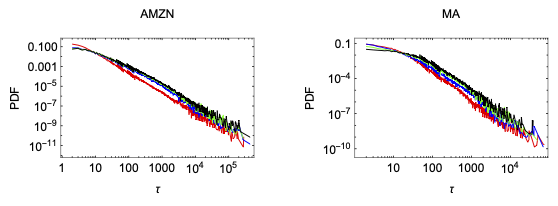
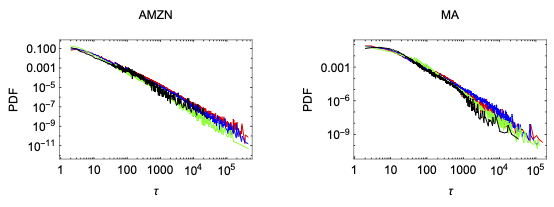
Pav. 2. AMZN ir MA akcijų pavedimų gyvavimo laikų histogramų pavyzdžiai. Empiriniai skirstiniai suskaičiuoti keturiems skirtingiems pavedimų dydžio intervalams. Didėjimo tvarka: raudonas, mėlynas, žalias ir juodas grafikai.
Kadangi pavedimų gyvavimo laikų skirstiniai akivaizdžiai yra laipsninio pobūdžio (grafikai yra dvigubai logaritminiane mastelyje), pasinaudojome galimybe pasitelkti neekstensyviąją Tsallio statistiką, t.y., parodėme, kad q-eksponentinis Tsallio skirstinys puikiai aprašo empirinį gyvavimo laikų pasiskirstymą. Papildydami šią empirinę statistinę savybę pavedimų apimčių (volume) laipsniniu empiriniu pasiskirstymu, suformulavome paprastą disbalanso laiko eilutės modelį, kuris esmingai pakeitė anksčiau naudotą Trupmeninį L’evy stabilų stochastinį procesą.
Pasirodė, kad ankstesnė TLSSP prielaida visai neblogai tinka tuo atveju, kai laiko eilutę formuojame tik iš akcijų rinkai pateikiamų pavedimų, bet išimame jų atšaukimus ir įvykdytus sandorius. Todėl atkreipiame dėmesį, kad šis konkretus empirinės laiko eilutės pavyzdys gražiai demonstruoja, kaip yra svarbu įsitikinti ar tyrimams naudojamos matematinės prielaidos yra tinkamos tiriamam objektui. Mūsų nuomone, empiriniuose laiko eilučių tyrimuose labai dažnai prielaidų galiojimas nėra tinkamai patikrinamas, o gaunami rezultatai, ypatingai ilgos atminties aspektu, yra klaidinantys. Tik pagrįstai įvertinę ilgos atminties egzistavimą fizinėse, socialinėse ar finansinėse sistemose, galime tikėtis sėkmės, prognozuodami laiko eilučių eigą ar skaičiuodami rizikas.
Šis darbas gali būti prasmingai pratęstas, jei pabandytume apjungti šiuos rezultatus su mūsų grupės kolegų publikacija [2]. Yra tikėtina, kad pavedimų laikų laipsniniai skistiniai stebimi todėl, kad rinka statistiškai apjungia labai įvairius agentus, prekiaujančius labai skirtingu intensyvumu, t.y., turinčius skirtingus charakteringus jų pavedimų gyvavimo laikus. Kviečiame susidomėjusius fizikos matemtikos studentus bei jaunus mokslininkus bendradarbiauti, tęsiant pradėtus darbus.
Literatūra.
- V. Gontis. Order flow in the financial markets from the perspective of the Fractional Lévy stable motion. Communications in Nonlinear Science and Numerical Simulation 105, 2022, psl. 106087. https://www.sciencedirect.com/science/article/pii/S1007570421003993. doi: https://doi.org/10.1016/j.cnsns.2021.106087.
- A. Kononovicius, B. Kaulakys. 1/f noise in electrical conductors arising from the heterogeneous detrapping process of individual charge carriers. (under review). arXiv:2306.07009 [math.PR].